Here We Are, Born To Be Kings
Zelanzy’s Demigod Drama
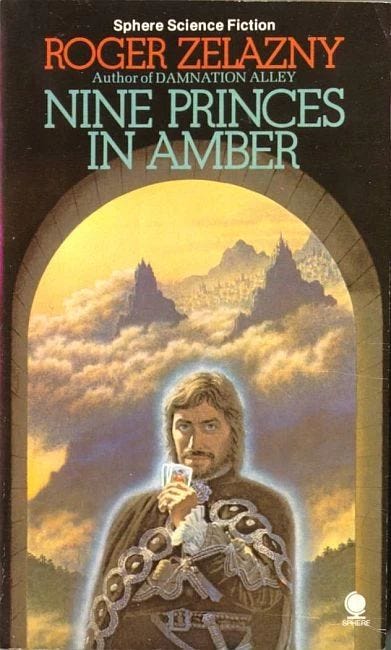
Roger Zelazny’s Amber series began its publication run during the years that Gygax and Arneson developed Braunstein into first Chainmail and then Dungeons & Dragons.
Among the things that Gygax saw in this series1 was the concept of an infinite stack of Shadows that, as appropriated for the game, became the infinite stack of Prime Material Planes. While there is no Original World to be the light that these Shadows are cast from—no Amber—the concept of a primordial Chaos, and with it a conflict of Order and Chaos, is not only present but foundational to the setting.
Furthermore, in a nod to the fashionability of Eastern mysticism and philosophy in the 1970s, each contained an essence of the other that permitted that necessary quality to allow for necessary drama to unfold.2
Combine that with the combination of soap opera and dynastic nastiness that most today associate with Martin’s Westeros, but done better, and you have Zelanzy’s true masterpiece of fantastic adventure- one that cares not about fake genre boundaries. It dances all over them like a drunken sailor in port, cold-cocks the authorities in the kidneys, and then beats feet back to sea before anyone can do anything about it.
As both sets of the Amber series focus on the scions of Amber, these are demigods compared to the rest of the denizens of Shadow (i.e. us). They only have opposition among their own kind as well as some of the tougher Lords of Chaos. It is this dynamic that Gygax brought into D&D, and we’ll see in Nine Princes this dynamic in action.
Next week, we’ll take a closer look at what Zelanzy put down that Gygax had to have for himself.
I am talking about the first series, focusing on Corwin. The second, focusing on Merlin, come later, but they would have influence on later editions of D&D as well as fantasy games like Earthdawn. It is that second series that expounded on Sorcery enough for Earthdawn to steal the concept entirely as “Spell Matrices”, and for Wizards of the Coast to tone down the raw Jack Vance concept of spell use to conform to Zelanzy’s model instead in 3rd Edition.
The essence of Order in Chaos allowed for the Chaos Lords to organize and undergo enough discipline to always present a viable threat to Amber. The essence of Chaos in Order kept Amber from being a wholly unified hivemind that prevented Amber from rubbing out Chaos entirely.
No replies yet — be the first.