Putting Skin In The Game
Players Care About What They Invest In

Continuing from Monday’s article, it is obvious as to why the classic settings of the Old Timers became what they were. The various mans they played, successfully, built up the setting over time by establishing and running Domains, creating Spells and Items, and engaging in various acts of both construction and destruction that shaped the land and the history of it. For those men, these settings are real in ways that we’ve now seen that most people (including the current corporate owners) do not.
They invested. Therefore they had skin in the game. They care about it because of that investment.
It is also because of that investment that the settings were resistant to being used for making products in other forms of entertainment media, and thus corporate owners (because calling them “caretakers” is not accurate) had to go about a lengthy process of revisionism to sand down edges and straightening out anti-Narrative curves until those settings were rendered fit for that purpose. In doing so, those investments got ruined and as such it is not surprising to see the old timers disengage increasingly as it went on.
It turns out that the same psychological phenomenon that is behind the devaluing of what what receives without earning it in a literal sense is also behind it in the metaphorical and virtual sense.1 When I wrote of the Revealed Preferences of players consistently showing a devaluing of a setting’s context, it stems from this position: it is handed to you, without any effort required or without any expectation to do so, thus it is not valued and is instead abused and disdained in favor of what those players put in place instead.2
This is a hobby built upon the fantasy of being The Man In Command. Part and parcel of that fantasy is that your man is willing and able to shape the context around him to his liking. In practice, this is not just defeating enemies and rivals. This is building up new locations, erecting new powers, establishing new institutions, and seeing through to maturity these acts of creation.
Build a new tower? That goes on the map. Carve a new dungeon? On the map. Drive a new road from A to B? On the map. Clear an area of hostiles? Change the Encounter Table for that part of the map. Make a new monster? Write it up and deploy it on the map. Find a new route to connect two places? Note the endpoints on the map(s) and run the route (as applicable) through it (them).
Each such act changes the context of the campaign. A new tower is a new place from which to operate, which extends the reach of the party in control of it and around it yet more can be erected- in time it could even build into a magnificent city (see the above picture).
Create a new spell? Now you have an edge on everyone else. Create a new item? Same. Find a way to reduce the time it takes to raise an army, or to reduce the cost of fielding it? Now you have an edge over everyone else, an edge that persists over time until it is copied or countered.
With each such act, the campaign’s context shifts due to what players do. Players thus invest in the campaign over time as they act within it, shaping things to their liking in one form or another. You start to care about what goes on in the campaign because you put down that investment, not of money but of time and emotion, and the more mans you play who start doing this the more you care about the campaign as a whole instead of one narrow sliver of it.
The result is that you care about your campaign. You crafted it, molded it, shaped it, as a potter shapes clay or a carpenter shapes wood, into the form it assumes over time. The tallying of those deeds, that construction, that destruction, the alliances and the betrayals, becomes history in a very real sense- and you care because it’s yours.
That does not translate to being sold for $50 in a boxed set to someone who never did any of it, and can’t comprehend how or why this setting is as it is. You’d think it would but after 50+ years we know that it does not. For those people your vibrant setting looks like this.
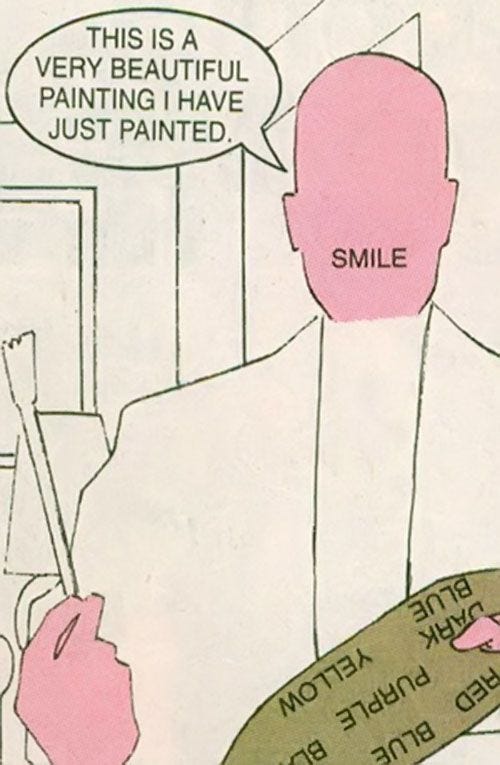
That’s all it is to them. Meaningless babble, of no substance, so ignorable- and it is.
This is why I argue against Official Settings as a product for play in favor of focusing on teaching hobbyists how to use the rules of the game3 to create their own settings from scratch as they go, in the proper manner, with the techniques that we’ve proven to work to maximize engagement and investment in a campaign.4
We care about what we put in work for. It’s as simple as that. Putting in work to shape a campaign has the same psychological effect as putting in work to buy a car, build a house, publish a novel, successfully raise children to maturity, or establish a business: you care, you want it to thrive, you see that it happens as best you can, and you learn a hell of a lot more by doing it. You don’t care about free stuff unless that’s all you have, and that’s why Official Settings get abused like red-headed step-children.
And if you want me to address how it could be made to work, you need to be here on Friday.
This, in turn, implies that the concept of Initiatory Rituals have more to their validity than just marking a Rite of Passage- but that’s for another conversation.
Most obvious in any setting based upon being part of a hierarchical organization, especially a military one, where players’ mans begin at the bottom of the hierarchy. Gaming horror stories are filled with Private Fuckyouavich doing Demand Avoidance Behaviors in a war zone that would get him executed on the spot in the best of times by immediate superiors.
Assuming that you have a proper and complete game, and not a crippleware product that is meant to compel you to buy more products to fix what the publishers deliberately broke. I am looking at almost everyone in Tabletop, as that is your business model.
Someone with sense would have figured this out and made a business out of providing this training as a service decades ago, but alas no we’re stuck with the consequences of Boomer stupidity.
No replies yet — be the first.